


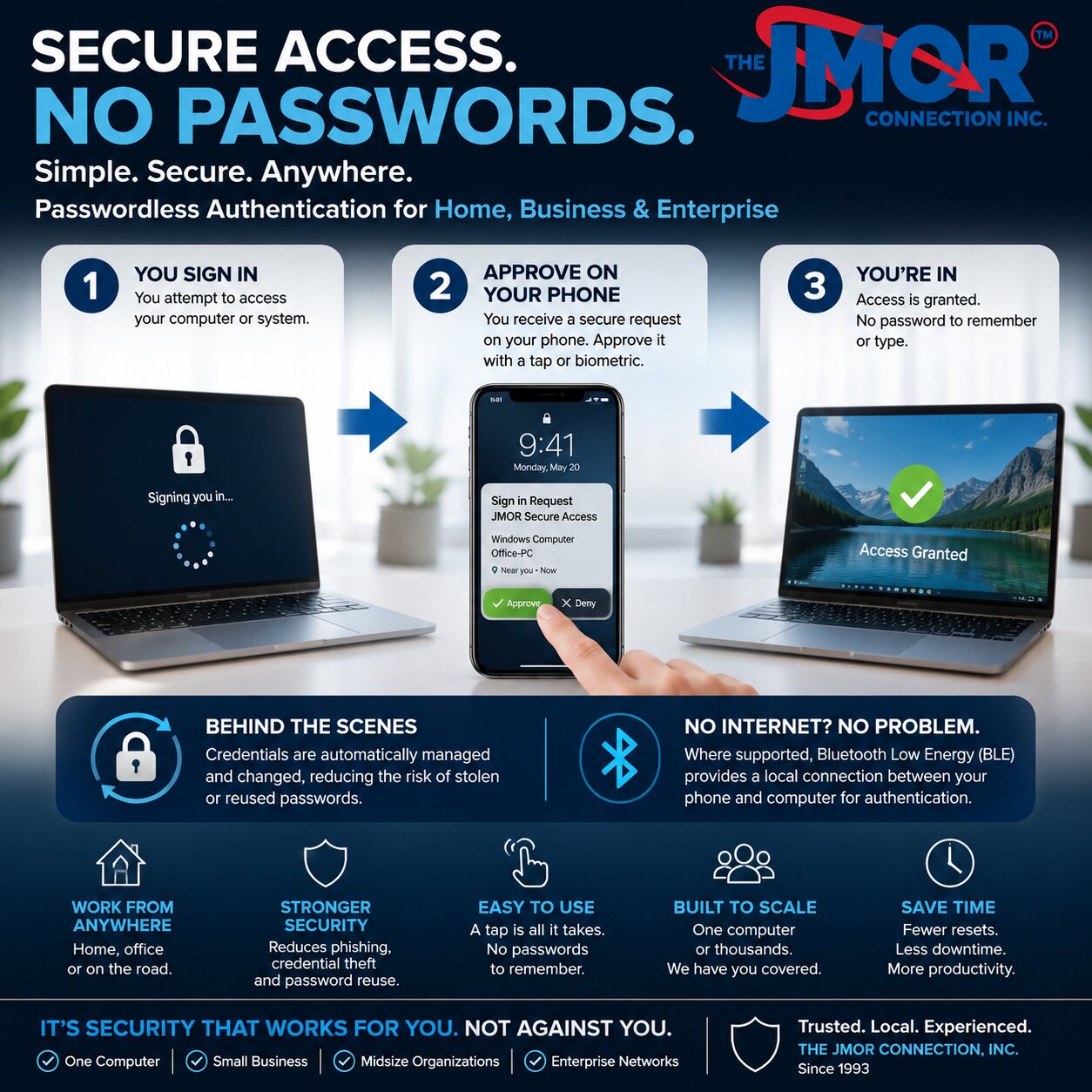
Passwordless Authentication Solutions: A Simpler, Smarter Way to Secure Access
For decades, one of the most familiar parts of using a computer has also been one of the most frustrating: the password.
We create them, forget them, reset them, reuse them, mistype them, write them down, and occasionally discover that one has been exposed somewhere we never expected. Businesses establish increasingly complex password requirements, while users struggle to remember which combination belongs to which system.
Meanwhile, cybercriminals have become remarkably effective at exploiting the human side of passwords.
Phishing emails attempt to convince users to surrender credentials. Fraudulent websites imitate legitimate login screens. Attackers try credentials exposed in previous breaches against other services. Password spraying attacks test commonly used passwords across numerous accounts. Social engineering can persuade people to reveal information they would ordinarily protect.
What if we could change the experience entirely?
What if you could sit down at your computer, authenticate securely using your phone, and continue working without needing to know or type the underlying password?
That is the idea behind passwordless authentication.
At The JMOR Connection, Inc., we believe security technology should accomplish two things that are sometimes treated as opposites: improve protection while making technology easier for legitimate users. Modern passwordless authentication provides an opportunity to do both.
Whether you have one computer at home, several computers in a small office, a growing midsize organization, or an enterprise network, passwordless authentication can fundamentally change the way users access their systems.
Why Traditional Passwords Have Become a Problem
Passwords were created for a computing environment very different from the one we use today.
The average person may now interact with dozens of applications, websites, cloud platforms, computers, mobile devices, financial services, and business systems. Asking users to create a different strong password for every service creates an obvious practical problem.
People have to remember them.
When password requirements become increasingly complicated, users naturally look for ways to make them manageable. They may reuse passwords, create predictable variations, store them insecurely, or choose passwords that satisfy technical requirements without necessarily providing strong protection.
Businesses face another challenge.
Password resets consume time.
An employee who cannot access a computer or application may be unable to work until the problem is resolved. Someone has to verify the user, reset the credential, communicate instructions, and potentially troubleshoot additional problems.
Multiply that process across dozens, hundreds, or thousands of users and password management becomes more than a security issue. It becomes an operational issue.
Passwordless authentication changes the conversation by reducing the user's dependence on a credential that must be remembered and manually entered.
What Does Passwordless Authentication Actually Mean?
The phrase can sound more complicated than the experience itself.
From the user's perspective, the concept can be remarkably straightforward.
You attempt to access your computer or protected system. Instead of being expected to remember and manually enter a traditional password, you receive an authentication request on your authorized phone. You approve the request and continue.
The underlying authentication technology handles the security process without requiring the user to routinely know or type the credential.
Depending on the solution and configuration, underlying credentials can also be automatically managed and rotated. This can significantly reduce the exposure associated with passwords that remain unchanged for long periods or are repeatedly entered by users.
The important distinction is that passwordless access does not mean security disappears.
Quite the opposite.
It means authentication is redesigned so that legitimate users can prove who they are without relying on the traditional process of remembering and repeatedly typing a reusable secret.
Your Phone Becomes Part of the Authentication Process
Most people already protect and carry a sophisticated authentication device every day: their smartphone.
A passwordless system can use that trusted device as part of the process of confirming that the person attempting to gain access is actually authorized.
When authentication is required, the user receives a prompt on the phone and approves the request.
That changes the experience substantially.
Instead of asking:
“What was my password?”
the user is asked:
“Am I actually trying to sign in right now?”
That is an easier question for most people to answer.
It can also create an important security benefit. An unexpected authentication request may alert a user that someone else is attempting to gain access.
Authentication should still be configured thoughtfully, and users should never blindly approve unexpected requests. Passwordless technology works best as part of a broader security strategy that includes user awareness and appropriate controls.
Automatically Managed Credentials Change the Risk Equation
Traditional passwords can remain unchanged for months or years.
That creates an obvious problem if a credential is ever exposed.
A stolen password can remain useful until it is changed, assuming the attacker can use it successfully and other security controls do not stop the attempt.
With a system capable of automatically managing and rotating underlying credentials, the credential does not need to remain static indefinitely.
More importantly, the user does not need to know it.
That reduces opportunities for the credential to be accidentally shared, written down, reused elsewhere, entered into a fraudulent website, or disclosed during a social engineering attempt.
No responsible security solution should be described as impossible to compromise. Cybersecurity involves reducing risk through appropriate technologies, configuration, monitoring, and user practices.
However, removing routinely handled passwords from the user's workflow can eliminate or substantially reduce several common ways traditional credentials are exposed.
What Happens If There Is No Internet Connection?
One of the first practical questions people may ask about phone based authentication is:
What happens when the Internet is unavailable?
That matters.
People travel. Internet connections fail. Wireless networks experience outages. A user may need access in a location where normal connectivity is temporarily unavailable.
Where supported by the passwordless solution and properly configured, Bluetooth Low Energy, commonly known as BLE, can provide a local communication path between the computer and the authorized mobile device.
That means authentication does not necessarily have to depend entirely upon an active Internet connection.
The computer and phone can communicate locally where the supported implementation permits it, allowing the authentication process to continue under circumstances in which normal Internet based communication is unavailable.
This capability can be particularly valuable for mobile professionals and organizations that need authentication to remain practical beyond a traditional office environment.
At Home, in the Office, or Traveling
Modern work no longer happens in one place.
An executive may begin the morning working from home, spend the afternoon in an office, and travel to another location the following day. Employees may work remotely several days each week. Consultants and field personnel may rarely operate from a traditional desk.
Security needs to follow the user.
Passwordless authentication can provide a more consistent authentication experience regardless of whether someone is working from home, at the office, or while traveling.
Instead of creating completely different login habits depending on location, users can work with a familiar authentication process centered around their authorized device.
That combination of mobility and security is one of the reasons passwordless technology deserves attention beyond large enterprise environments.
Passwordless Security Is Not Just for Large Companies
Advanced authentication technology is often presented as something intended only for organizations with thousands of employees.
That does not have to be the case.
The underlying problem exists at every scale.
A homeowner with one computer can forget a password.
A small business employee can fall for a phishing attempt.
A growing company can spend unnecessary time dealing with credential problems.
An enterprise can face enormous administrative and security exposure from thousands of user passwords.
The scale changes.
The fundamental problem does not.
Passwordless Authentication for Home Users
Consider someone with a single home computer.
That computer may contain financial information, tax documents, personal correspondence, photographs, saved browser sessions, business information, and access to cloud services.
Security matters even though there is no corporate network.
A passwordless authentication solution can provide a more convenient way to secure access without requiring the individual to continually remember and manage a traditional computer password.
For someone who works from home, the distinction between personal and professional technology may be even smaller. The same computer may provide access to business email, documents, cloud services, financial systems, and other sensitive resources.
Strong authentication is therefore not exclusively a corporate concern.
Passwordless Authentication for Small Businesses
Small businesses face a particularly interesting authentication challenge.
They may not have a large internal IT department, yet they depend heavily on technology.
Every hour spent resetting passwords, resolving login problems, or responding to a compromised credential takes attention away from the business itself.
A passwordless approach can simplify the user experience while strengthening the organization's authentication strategy.
Employees no longer need to be responsible for remembering an underlying password they routinely type into the computer. Authentication can instead become an intentional approval process through the authorized device.
As the business grows, that approach can scale with it.
Growing With Midsize Organizations
As organizations expand, credential management becomes increasingly complicated.
More employees mean more accounts, more devices, more remote workers, more onboarding, more departures, and more opportunities for mistakes.
The security implications also grow.
A midsize organization may have accounting personnel, executives, sales teams, administrators, remote employees, operations staff, and other groups accessing different resources from different locations.
Passwordless authentication can become part of a broader identity and access strategy designed to improve security without creating unnecessary friction for employees.
The goal is not simply to remove passwords from view.
The goal is to create a more manageable and controlled authentication environment.
Passwordless Authentication at Enterprise Scale
At enterprise scale, even small inefficiencies become significant when multiplied across hundreds or thousands of users.
Password related support requests can consume substantial administrative resources. Credential based attacks can create significant security exposure. Employees may work from offices, homes, client locations, hotels, airports, and other environments.
Passwordless authentication can help organizations rethink this traditional dependency.
A properly designed deployment can provide users with a consistent authentication experience while allowing the organization to maintain centralized security policies and management appropriate to the environment.
As with any enterprise technology, planning becomes essential.
Authentication touches virtually every user, which means deployment should account for infrastructure, security requirements, user experience, support procedures, device compatibility, recovery scenarios, and organizational policies.
Phishing Becomes a Different Conversation
Phishing remains one of the most persistent cybersecurity problems because it attacks people rather than simply attacking technology.
A convincing message can direct someone to a fraudulent login page that looks remarkably similar to a legitimate service.
Traditional authentication creates an obvious opportunity: the user knows the password and can therefore be persuaded to type it somewhere.
When the user does not routinely know or type the underlying credential, that particular attack path can be substantially reduced.
This does not mean phishing disappears.
Attackers continually adapt, and users can still be targeted through fraudulent authentication requests, social engineering, malicious software, and other techniques.
But changing the authentication model can remove one of phishing's most familiar targets: a reusable password sitting in the user's memory.
Convenience and Security Do Not Have to Be Enemies
Security has historically developed a reputation for making technology harder to use.
Longer passwords.
More complicated password rules.
Frequent password changes.
Additional login screens.
More things to remember.
Users sometimes see security as something standing between them and the work they need to accomplish.
That can be counterproductive.
When security controls become excessively burdensome, people naturally search for shortcuts.
A well designed passwordless experience can move in the opposite direction.
The user experience becomes simpler while the authentication process becomes more sophisticated behind the scenes.
That is an important principle for JMOR.
Good security should protect legitimate users without unnecessarily punishing them for being legitimate users.
Passwordless Authentication Should Be Part of Layered Security
Passwordless authentication is powerful, but it should not be treated as a replacement for every other cybersecurity measure.
Organizations still need to think about endpoint protection, network security, firewalls, software updates, backups, secure wireless networks, access controls, monitoring, and security awareness.
Authentication is one layer.
A strong cybersecurity strategy uses multiple layers that complement one another.
If one control is challenged, another may help prevent a security event from becoming something much larger.
Passwordless authentication can strengthen one of the most important layers by changing how users prove their identity.
Planning for the Unexpected
Any authentication strategy also needs to consider what happens when normal conditions change.
What happens if someone replaces a phone?
What happens if the phone is lost?
What happens when an employee leaves the organization?
What happens when a computer is replaced?
What happens when connectivity is unavailable?
What recovery procedures exist?
These are not reasons to avoid passwordless authentication.
They are reasons to implement it properly.
A security solution should account for normal use as well as exceptions. Planning recovery and administrative procedures before deployment helps ensure that stronger authentication does not become an operational obstacle when circumstances change.
The JMOR Approach to Passwordless Authentication
At The JMOR Connection, Inc., we have been helping people and businesses make technology decisions since 1993.
During that time, computing has changed dramatically.
We have watched standalone computers become interconnected networks. The Internet became essential to everyday business. Cloud computing changed where applications and information live. Mobile devices transformed how people work. Cybersecurity evolved from an occasional technical concern into an operational necessity.
Passwords, however, have remained remarkably persistent.
We believe it is worth asking whether the traditional password experience still makes sense for every user and every organization.
Our approach to passwordless authentication begins with understanding the environment.
Is this for one home computer?
A small office?
A growing organization?
A distributed workforce?
An enterprise network?
Where do people work?
What happens when they travel?
What security requirements exist?
What needs to happen when Internet connectivity is unavailable?
Technology should fit the people and organization using it rather than forcing every environment into the same configuration.
One Computer or an Entire Organization
One of the most compelling aspects of passwordless authentication is that the idea is easy to understand regardless of scale.
One computer at home.
Several users in a small business.
A growing midsize organization.
Hundreds or thousands of users across an enterprise.
The objective remains consistent:
Reduce dependence on passwords users must remember, repeatedly type, and protect themselves.
Allow users to authenticate through a trusted device.
Manage the underlying authentication process more securely.
Provide an experience capable of following users wherever legitimate work takes them.
What If You Never Had to Remember Another Password?
For decades, we have accepted passwords because that was simply how computer authentication worked.
Perhaps it is time to reconsider that assumption.
Imagine sitting down at your computer and not wondering which password you used.
Imagine eliminating another password reset.
Imagine employees no longer writing computer passwords on pieces of paper.
Imagine reducing the opportunity for someone to surrender a reusable credential to a fraudulent login page.
Imagine authentication that can follow you from home to the office and on the road.
And when supported by the solution, imagine having a local BLE authentication option available when normal Internet connectivity is not.
That is what makes passwordless authentication interesting.
It is not simply another security product.
It represents a different approach to one of computing's oldest problems.
At The JMOR Connection, Inc., we help home users, small businesses, midsize organizations, and enterprise environments evaluate technology based on what they actually need.
If remembering, resetting, protecting, and managing passwords feels like a problem technology should have solved by now, passwordless authentication may be worth exploring.
One computer or an entire network. At home, in the office, or traveling.
The password may finally be something you no longer have to think about.
Helping people and businesses make better technology decisions since 1993.