


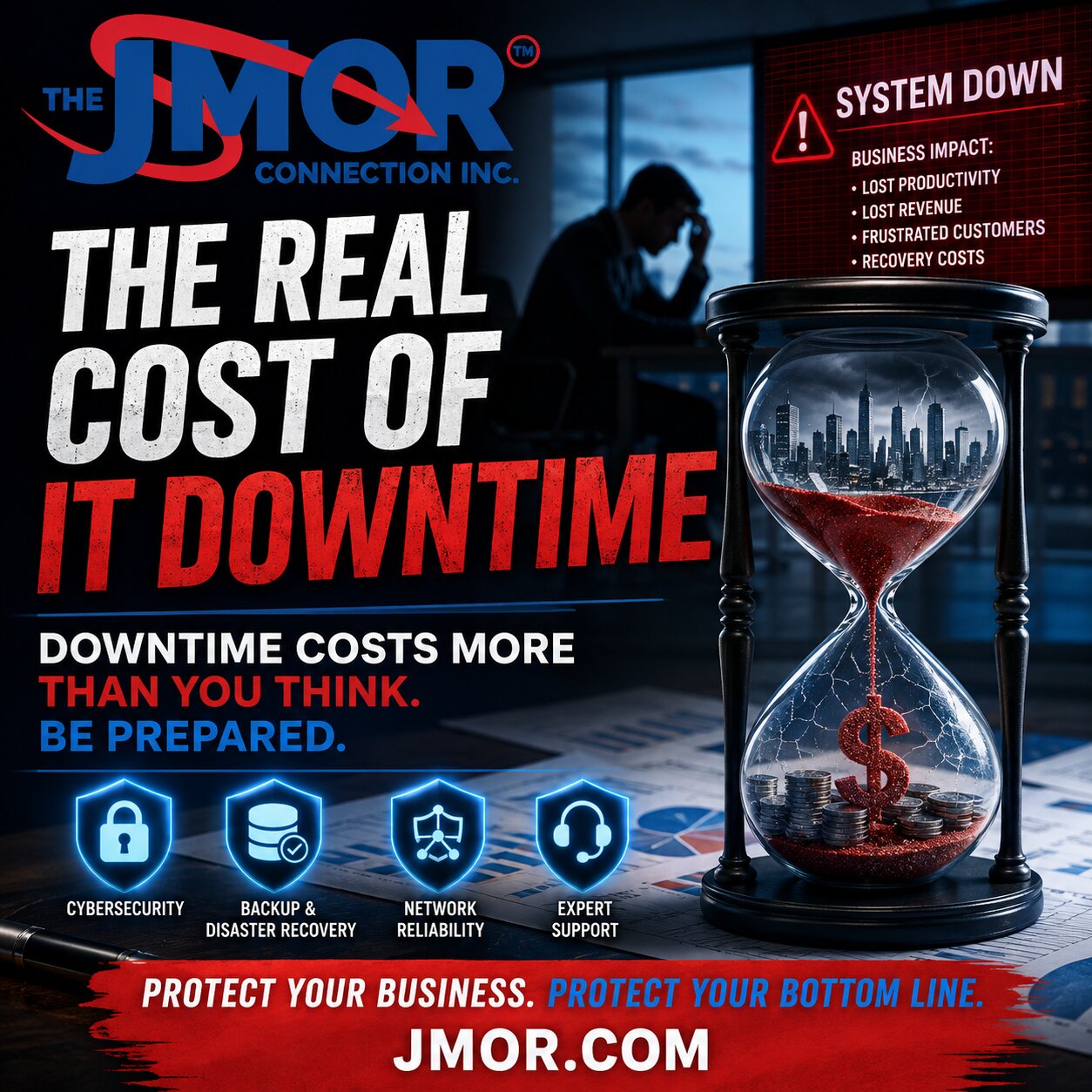
How Much Is IT Downtime Really Costing Your Business?
Technology is so deeply integrated into modern business operations that many organizations don't fully appreciate its value until something stops working. A server becomes unavailable, an Internet connection fails, employees lose access to a critical application, a network problem interrupts communication, or a cybersecurity incident forces systems offline. What initially appears to be a technical problem can quickly become an operational and financial problem affecting employees, customers, vendors, and the organization as a whole.
When businesses evaluate technology expenses, they often focus on visible costs. How much does a computer cost? What is the monthly price of an Internet connection? How much will an IT professional charge to repair a server? What does cybersecurity protection cost? These are reasonable questions, but they address only one side of the financial equation.
The other side is harder to see: What does it cost the business when the technology it depends on is unavailable?
For some organizations, an hour of downtime may create little more than an inconvenience. For others, even a relatively short interruption can prevent employees from working, stop transactions, interrupt customer service, delay production, make important information inaccessible, and create a backlog that continues long after systems have been restored.
No single universal figure accurately represents the cost of IT downtime for every organization. A small professional office, manufacturer, medical practice, retailer, nonprofit organization, and large corporation have very different technology dependencies and financial exposures. Rather than relying on an arbitrary industry statistic, businesses should understand their own operations well enough to determine what downtime could actually mean for them.
That process begins by recognizing that the true cost of downtime extends considerably beyond the initial technology failure.
Downtime Is a Business Problem, Not Just an IT Problem
Imagine arriving at the office tomorrow morning and discovering that employees cannot access the systems they need to work. Perhaps the Internet connection is unavailable, the primary server will not start, a critical application is inaccessible, or a network failure has disconnected several departments.
The immediate reaction may be to call the IT provider and ask how quickly the problem can be repaired. While that is certainly important, another clock has already started.
Employees may be waiting. Customers may be calling. Orders may not be processed. Files may be inaccessible. Salespeople may be unable to retrieve information. Accounting functions may be interrupted. Management may be pulled away from normal responsibilities to deal with the disruption. Depending upon the organization, phones, cloud applications, security systems, remote employees, and other services may also be affected.
Even after the original technical problem has been corrected, the financial impact may continue. Employees have to catch up on work that accumulated during the outage. Customer requests may need additional attention. Transactions may have to be reconstructed. Management may need to review what happened and determine whether additional corrective measures are necessary.
This is why downtime should be evaluated as an operational business risk, rather than simply as the cost of an IT repair.
Start With the Cost of Lost Employee Productivity
One of the easiest components of downtime to understand is employee productivity.
Suppose ten employees depend upon a particular server, network connection, or business application. If that system becomes unavailable for two hours and those employees cannot perform their normal responsibilities, the organization has potentially lost twenty employee hours of productive capacity.
That does not mean every minute of those twenty hours represents a complete financial loss. Employees may be able to perform other tasks, make phone calls, organize paperwork, attend meetings, or temporarily work around the problem. However, those alternative activities may not represent the work the organization actually needed them to accomplish at that time.
The calculation becomes considerably more significant as the number of affected employees increases.
A network outage affecting one employee is very different from an outage affecting an entire department. A server problem affecting twenty people is very different from a problem involving one workstation.
Businesses should therefore consider not only how long a system could be unavailable, but also how many people and business processes depend upon it.
Lost Productivity Is Only the Beginning
Employee time is one of the most visible costs of downtime, but it may not be the largest.
A business also needs to consider what those employees would have accomplished if the technology had remained available.
Could a salesperson lose an opportunity because customer information was inaccessible? Could an order be delayed because employees could not process it? Could a customer choose another company because nobody could provide the information they needed? Could a service appointment need to be rescheduled? Could production stop because a system controlling part of the workflow was unavailable?
These losses are more difficult to calculate because they do not always appear on an invoice.
A customer who becomes frustrated and quietly chooses a competitor does not send the business a bill explaining why. A salesperson who misses an opportunity may never know what the transaction would have been worth. A delayed project may create additional costs elsewhere in the organization.
This is why the financial impact of downtime should be considered in terms of both direct costs and lost opportunities.
Customer Experience Can Become Part of the Cost
Customers generally do not care which server failed, which network device stopped responding, or why a particular application became unavailable. They experience the business result.
They may hear that an employee cannot access their account. They may be told that an order cannot currently be processed. They may be unable to reach the organization through its normal communication channels. A promised response may be delayed because the information required to provide it is inaccessible.
A short interruption handled professionally may have little lasting effect. Repeated outages or a prolonged disruption can create a very different impression.
Reliability is part of the customer experience, even when customers never see the technology that makes it possible.
This becomes particularly important for businesses operating in competitive markets. Technology problems that repeatedly interfere with customer service can eventually become relationship problems, and relationship problems can become revenue problems.
Internet and Network Downtime Can Affect More Than Web Browsing
There was a time when losing an Internet connection might have meant employees could not browse websites or send email for a while. Modern business environments can be considerably more dependent upon connectivity.
Cloud applications, hosted telephone systems, remote access, payment processing, online ordering, vendor portals, file synchronization, cybersecurity services, video conferencing, software licensing, and numerous other systems may rely upon Internet and network connectivity.
That means an Internet or network failure can potentially interrupt several business functions simultaneously.
The same applies to internal network problems. Poorly performing switches, wireless infrastructure, cabling, firewalls, DNS configuration, or other networking components can create symptoms that appear unrelated even though they originate from the same underlying infrastructure.
A business that experiences recurring connectivity problems should therefore consider more than the inconvenience of slow WiFi. It should consider the cumulative employee time and operational capacity lost because the network is not providing the reliability the organization requires.
Server Failure Can Turn Minutes Into Hours or Days
A failed workstation can inconvenience an individual employee. A failed server can affect an entire organization.
The extent of the disruption depends upon what the server provides. It may contain shared files, applications, databases, authentication services, printing resources, or other systems required for daily operations.
Replacing failed hardware is only one part of recovery.
A replacement server may need to be obtained, configured, updated, secured, connected to the network, and prepared for the applications and data the organization requires. Operating systems may need to be restored. Applications may need to be installed or recovered. Permissions and configurations may need to be recreated. Data may need to be restored and validated.
This is one reason business continuity and disaster recovery should be considered separately from simply having a backup.
Having a copy of important data is essential. Still, the business also needs to understand how that information will be made usable again and how long the process is expected to take.
A Backup Does Not Automatically Mean Fast Recovery
Businesses sometimes discover during an emergency that their expectations of a backup system and its actual capabilities are very different.
A backup may contain the necessary files, yet recovering an entire operating environment could still require considerable time. The organization may also discover that certain information was not included, that backups were not occurring as expected, or that nobody had recently tested whether information could be restored successfully.
A stronger recovery strategy asks questions before the emergency occurs.
What systems are critical? How frequently should they be protected? How much recent information could the business tolerate losing? How quickly does a critical system need to become operational again? Where are backup copies located? What happens if the physical building cannot be accessed? Has the recovery process actually been tested?
These questions are central to a thoughtful Business Continuity and Disaster Recovery, or BCDR, strategy.
The objective is not simply to say that backups exist. The objective is to determine whether the organization can recover the systems and information necessary to continue operating within an acceptable period of time.
Cybersecurity Incidents Can Create an Entirely Different Kind of Downtime
Not every technology interruption begins with failed hardware.
A compromised account, malware infection, ransomware incident, unauthorized access attempt, or other cybersecurity event can require systems to be disconnected intentionally while the situation is investigated and contained.
In those circumstances, getting the computers running again as quickly as possible may not be the only objective. The organization may first need to understand what occurred, which systems were affected, whether unauthorized access remains possible, what information may have been exposed, and what corrective actions are necessary before normal operations can safely resume.
That can transform a security incident into a continuity problem.
Appropriate endpoint management and protection, properly configured business firewall and UTM protection, network security, access controls, updates, backups, and user practices all contribute to reducing risk. No individual product can eliminate every cybersecurity threat, which is why security should be approached as a collection of complementary controls rather than a single appliance or software package.
The financial impact of a cybersecurity incident may extend beyond technical recovery and include operational disruption, professional services, customer communication, management time, and other consequences, depending on the nature of the event.
Emergency Technology Purchases Can Be Expensive in More Ways Than One
Technology purchased during an emergency is rarely purchased under ideal circumstances.
If a critical server fails unexpectedly, the organization's priority may be finding equipment that is available immediately rather than selecting equipment that best supports its long-term requirements. Expedited shipping may become necessary. Employees may need to work outside normal hours. IT professionals may need to prioritize emergency work. Temporary equipment or workarounds may be required.
The organization is making decisions under pressure because every additional hour of downtime has consequences.
Planned technology replacement is fundamentally different.
When an organization monitors equipment lifecycles, it can evaluate requirements, budget for replacement, select appropriate equipment, schedule installation, migrate information carefully, test the environment, and minimize disruption.
Not every hardware failure can be predicted, but organizations should not be surprised when equipment that has been operating for many years eventually needs replacement.
The difference between planned maintenance and emergency recovery can be substantial.
The Hidden Cost of Management Attention
One cost of downtime that businesses frequently overlook is management attention.
When an important technology system fails, managers and owners may become directly involved. They communicate with employees, contact vendors, make decisions about expenditures, answer customer questions, rearrange schedules, approve emergency work, and continually ask when systems will become available again.
Those managers are no longer concentrating on the responsibilities that normally create value for the organization.
A two-hour technical outage can therefore consume far more than two hours of organizational attention.
If several managers, employees, vendors, and technology professionals become involved, the cumulative impact can become considerable even before lost revenue is considered.
This is another reason recurring technology failures deserve more attention than repeatedly fixing the immediate symptom. Every recurrence consumes organizational resources again.
Recovery Time Matters as Much as Failure Prevention
Businesses sometimes approach technology planning with an unrealistic objective: preventing anything from ever failing.
That is not possible.
Hardware can fail. Internet providers can experience outages. Software can malfunction. Buildings can lose power. Employees can make mistakes. Security incidents can occur. Natural events can disrupt facilities.
A mature technology strategy therefore addresses two different questions.
What can reasonably be done to reduce the likelihood of disruption?
And equally important:
What happens when disruption occurs anyway?
The second question is where recovery planning becomes critical.
A business may decide that a particular system can remain unavailable for a day without creating significant consequences, while another system may need to be restored within an hour. Understanding those differences allows the organization to allocate resources according to actual business requirements rather than treating every technology component as equally important.
How Should a Business Estimate Its Own Downtime Cost?
There is no responsible way to assign one universal dollar figure to every hour of business downtime. The calculation should reflect the organization itself.
A useful starting framework is:
Employee productivity cost + lost or delayed revenue + recovery expenses + customer impact + secondary operational costs = estimated downtime impact
Each component deserves consideration.
Employee productivity cost includes the time employees cannot spend on their normal responsibilities.
Lost or delayed revenue considers transactions, appointments, orders, production, billable work, and opportunities affected by the interruption.
Recovery expenses can include technology labor, replacement hardware, expedited services, temporary solutions, and other direct costs associated with restoring operations.
Customer impact considers delayed service, missed commitments, lost opportunities, and potential damage to customer relationships.
Secondary operational costs can include management time, overtime, rescheduling, backlog processing, vendor involvement, and the additional work required after systems become available again.
The purpose of this exercise is not to produce a perfectly precise number. In many situations, that would be impossible.
The purpose is to understand the scale of the business risk.
If an organization discovers that several hours without a particular system could cost substantially more than maintaining or improving that system, technology planning looks very different.
Not Every System Has the Same Business Value
One of the most important outcomes of evaluating downtime is identifying which systems are genuinely critical.
A malfunctioning secondary printer may be inconvenient but manageable. Losing access to the organization's primary customer database may be significantly more serious.
Businesses should identify the technology dependencies that most affect operations and prioritize them accordingly.
That could include Internet connectivity, servers, cloud applications, accounting systems, customer management platforms, phone systems, manufacturing systems, shared files, authentication services, or other technology unique to the organization.
Once those dependencies are understood, business network and cybersecurity infrastructure, backup strategies, equipment lifecycle planning, documentation, and support arrangements can be evaluated according to business importance.
Technology decisions become much more effective when they begin with the business requirement rather than the product.
The Cheapest IT Strategy Is Not Always the Least Expensive
It's understandable to evaluate technology primarily by its immediate price.
Businesses have budgets, and technology expenditures need to make financial sense. Spending more money does not automatically produce a better technology environment.
At the same time, the lowest initial cost does not necessarily create the lowest overall business cost.
An inexpensive piece of equipment that fails frequently, inadequate backup that requires days of recovery, unreliable networking that wastes employee time, or deferred maintenance that eventually produces an emergency can cost considerably more than the original savings.
The more useful question is not simply, “How much does this technology cost?”
It is:
“What does the business receive in reliability, security, productivity, recoverability, and useful life for that investment?”
That perspective allows organizations to make technology decisions based upon value rather than price alone.
Proactive IT Is Ultimately About Business Continuity
A proactive technology strategy does not mean replacing equipment simply because something newer exists. It does not mean purchasing every available cybersecurity product or eliminating every possible risk.
It means understanding the environment well enough to make deliberate decisions before circumstances make those decisions for you.
That includes knowing which systems are critical, maintaining appropriate documentation, monitoring equipment lifecycle, addressing recurring problems, keeping security controls current, understanding backup and recovery capabilities, evaluating network reliability, and discussing future business requirements before they become urgent.
As we discussed in our article about whether your business has outgrown break-fix IT, the difference between reactive and proactive technology management is not that problems disappear. The difference is that the organization spends less of its technology strategy waiting for the next emergency.
How Long Could Your Business Afford to Be Down?
That may be one of the most important technology questions a business can ask.
Not every organization needs the same recovery capability. Not every system needs immediate restoration. Not every technology risk requires the most expensive solution available.
However, every organization that depends upon technology should understand what would happen if its critical systems suddenly became unavailable.
How many employees would be affected? Which customers would be impacted? What work would stop? What information would become inaccessible? How quickly could operations be restored? Who would be responsible for recovery? Has that process ever been tested?
Those questions are considerably easier to answer before a failure occurs.
JMOR Connection, Inc. has worked with technology since 1993, helping businesses and organizations understand, maintain, protect, and improve the systems they depend on. From networks and cybersecurity to endpoint management, backup and disaster recovery, infrastructure, and ongoing technology planning, the objective should always be to make technology support the organization rather than repeatedly interrupt it.
You may not be able to prevent every technology failure. You can, however, understand the potential consequences, identify your most important systems, prepare appropriate recovery strategies, and make better decisions before an interruption becomes an expensive emergency.
The real cost of downtime is not simply what it costs to repair the technology. It is what happens to the business while everyone is waiting for that technology to come back.